Are you looking for DAV Books Solutions then you are in right place, we have discussed the solution of Science class 8 book Chapter 7 Combustion which is followed in all DAV School. Solutions are given below with proper Explanation please bookmark our website for further updates!! All the Best !!
DAV Class- 8 Science Combustion Question and Answer
Something To Know
A. Fill in the blanks.
1.A good fuel should have its ignition temperature above the room temperature.
2.Burning of cowdung cakes is an example of slow combustion.
3. The innermost zone of a candle flame, is the coldest.
4.The non-luminous zone of a candle flame is the outemost part of the flame.
5.During incomplete combustion of a fuel, carbon monoxide gas is formed.
B. State True or False for the following statements.
1. Coal is an inflammable fuel.
False
2. The outermost part of a candle flame contains unburnt carbon particles.
False
3. The heat produced, by burning completely one kilogram of a given fuel, is known as the efficiency of that fuel.
True
4. All solid fuels have a higher calorific value than liquid and gaseous fuels.
False
5. Sulphur dioxide gas, produced during combustion of fossil fuels, causes acid rain.
True
C. Tick (✓) the correct option.
1. An example of a non-combustible substance is-
Answer: iron
2. A fuel starts burning only when it is heated to-
Answer: its ignition temperature
3. The highest temperature zone of a candle flame, is its-
Answer: blue zone
4. The amount of heat produced, on complete burning of 10 kg of a given fuel, in pure oxygen, equals H kilojoule. The calorific fuel, of that fuel, would equal-
Answer: (0.1 H) kJ/kg
5. The gas produced, due to incomplete combustion of carbon fuels, is-
Answer: carbon monoxide
D. Answer the following questions in brief.
1. Define the term ‘combustible material’? Give two examples of combustible materials.
Answer:
2. State the three conditions that are needed for combustion to take place.
Answer:
3. State the condition under which ‘slow combustion of a material takes place.
Answer:
4. Define ‘calorific value of a fuel.
Answer:
5. State any two characteristics of an ideal fuel.
Answer:
6. Why is water not used in controlling electrical fires?
Answer:
E. Answer the following questions.
1. Draw a diagram showing the different zones of candle flame. Label the zone which contains:
(a) unburnt vapours of wax.
Answer: Innermost zone
(b) unburnt carbon particles.
Answer: Middle zone
2. Calorific value of wood is 18,000 kJ/kg. How much of wood is required to produce 360,000 kJ of heat energy?
Answer:
3. Why are gaseous fuels considered better than liquid or solid fuels.
Answer:
4. Why do we say that ‘burning of fuels’ can cause ‘health hazards’?
Are you looking for DAV Books Solutions then you are in right place, we have discussed the solution of Science class 8 book Chapter 7 Combustion which is followed in all DAV School. Solutions are given below with proper Explanation please bookmark our website for further updates!! All the Best !!
DAV Class- 8 Science Combustion Question and Answer
Something To Know
A. Fill in the blanks.
1.A good fuel should have its ignition temperature above the room temperature.
2.Burning of cowdung cakes is an example of slow combustion.
3. The innermost zone of a candle flame, is the coldest.
4.The non-luminous zone of a candle flame is the outemost part of the flame.
5.During incomplete combustion of a fuel, carbon monoxide gas is formed.
B. State True or False for the following statements.
1. Coal is an inflammable fuel.
False
2. The outermost part of a candle flame contains unburnt carbon particles.
False
3. The heat produced, by burning completely one kilogram of a given fuel, is known as the efficiency of that fuel.
True
4. All solid fuels have a higher calorific value than liquid and gaseous fuels.
False
5. Sulphur dioxide gas, produced during combustion of fossil fuels, causes acid rain.
True
C. Tick (✓) the correct option.
1. An example of a non-combustible substance is-
Answer: iron
2. A fuel starts burning only when it is heated to-
Answer: its ignition temperature
3. The highest temperature zone of a candle flame, is its-
Answer: blue zone
4. The amount of heat produced, on complete burning of 10 kg of a given fuel, in pure oxygen, equals H kilojoule. The calorific fuel, of that fuel, would equal-
Answer: (0.1 H) kJ/kg
5. The gas produced, due to incomplete combustion of carbon fuels, is-
Answer: carbon monoxide
D. Answer the following questions in brief.
1. Define the term ‘combustible material’? Give two examples of combustible materials.
Answer:
2. State the three conditions that are needed for combustion to take place.
Answer:
3. State the condition under which ‘slow combustion of a material takes place.
Answer:
4. Define ‘calorific value of a fuel.
Answer:
5. State any two characteristics of an ideal fuel.
Answer:
6. Why is water not used in controlling electrical fires?
Answer:
E. Answer the following questions.
1. Draw a diagram showing the different zones of candle flame. Label the zone which contains:
(a) unburnt vapours of wax.
Answer: Innermost zone
(b) unburnt carbon particles.
Answer: Middle zone
2. Calorific value of wood is 18,000 kJ/kg. How much of wood is required to produce 360,000 kJ of heat energy?
Answer:
3. Why are gaseous fuels considered better than liquid or solid fuels.
Answer:
4. Why do we say that ‘burning of fuels’ can cause ‘health hazards’?
Chapter 6 | Sources of Energy | Class- 8 DAV Science Solutions
Are you looking for DAV Books Solutions then you are in right place, we have discussed the solution of Science class 8 book Chapter 5 Sources of Energy which is followed in all DAV School. Solutions are given below with proper Explanation please bookmark our website for further updates!! All the Best !!
DAVClass- 8 ScienceSources of Energy Question and Answer
Something To Know
A. Fill in the blanks.
1. Coal and petroleumare non-renewable sources of energy.
2.Woodis a major renewable, natural resource.
3.The process, in which coal is strongly heated in the absence of air, is known as destructive distillation.
4. In oil wells, Natural gas is always found above the layer of petroleum.
5. Coal tar is a black viscous liquid, obtained by destructive distillation of coal.
B. State True or False for the following statements.
1. Fossil fuels are renewable natural resources.
Answer: False
2. Anthracite has higher carbon content than lignite.
Answer: True
3. Coke can be used to make fuel gases.
Answer: True
4. Natural gas is found below the petroleum layers.
Answer: False
5. Burning of fossil fuels is a major source of pollution.
Answer: True
C. Tick (✓) the correct option.
1. The highest grade of coal is known as-
Answer: Anthracite
2. Coke and coal tar are obtained from-
Answer: Coal
3. Different types of coal generally have the-
Answer: different content of volatile material as well as different percentage of carbon.
4. A product, that is not obtained through the refining of petroleum, is-
Answer: Coal gas
5. Which of the following is a renewable source of energy?
Answer: Tidal energy
D. Answer the following questions in brief.
1. Define the term ‘fuel’.
Answer: Substances which produce heat on burning in air are called fuels.
2. Name any two renewable natural sources of energy.
Answer: Wind energy and water energy.
3. Define the term ‘carbonisation’.
Answer: The process, of conversion of dead plant materials into coal, is called carbonisation.
4. Name the three main products obtained from destructive distillation of coal.
Answer: Coke, Coal Tar & Coal gas.
5. State two uses each of the following:
(a) asphalt
Answer: Two uses of asphalt are:
It is used for roads construction.
It is also used for coating the underside of electric poles to prevent their rusting.
(b) paraffin wax
Answer: Two uses of paraffin wax are:
It is used as grease.
It is also used for making vaseline, ointments and candles.
6. Write the full forms of CNG, LPG and PNG.
Answer:
CNG
Compressed Natural Gas.
LPG
Liquified Petroleum Gas.
PNG
Piped Natural Gas.
E. Answer the following questions.
1. Describe, in brief, the process of ‘coal formation’.
Answer: Coal was formed from plant remains got buried deep under the earth’s crust. Over a large period of time, the chemical and physical properties of these plant remain were changed through geological action that leads to the creation of the solid material i.e., Coal.
2. Differentiate between lignite and bituminous coal.
Answer: Differentiate between lignite and bituminous coal are:
Lignite Coal
Bituminous Coal
1. It has carbon content of about 38 per cent.
1. It has carbon content about 65 per cent.
2. It has been mainly used for electric power generation.
2. It is used for making coke (other type of fuel) and also for power generation.
3. It produces low heat energy.
3. It produces more heat energy.
4. It has high moisture content.
4. It has low moisture content.
5. It is regarded as the lowest grade of coal.
5. It is regarded as the middle grade coal.
3. How do petroleum and natural gas occur in nature?
Answer: Petroleum is found at moderate depths (500m – 2000m) between two layers of impervious rocks. Petroleum deposits are usually found mixed with salt water. Petroleum being lighter than salt water, floats over it. Natural gas is found above petroleum; it is trapped between the rock cap and the petroleum layer.
4. State the main advantages of using natural gas.
Answer: The main advantages of using natural gas are:
It burns readily and has a high calorific value.
It is easy to carry and store.
It undergoes complete combustion and can be controlled easily.
It is a cleaner fuel as it releases relatively low amounts of gaseous pollutants.
Do not leave ash particles after burning.
5. Keeping in mind their availability in nature, explain the need of using coal and petroleum judiciously.
Answer: Coal and petroleum are finite resources that take millions of years to create. They are non-renewable, in other words. As a result, these fossil fuels should be used wisely so that future generations will have access to them for valuable products.
Are you looking for DAV Books Solutions then you are in right place, we have discussed the solution of Science class 8 book Chapter 5 Friction which is followed in all DAV School. Solutions are given below with proper Explanation please bookmark our website for further updates!! All the Best !!
DAVClass- 8 ScienceFriction Question and Answer
Something To Know
A. Fill in the blanks.
1. Friction always opposes any relative motion between the two surfaces that are in contact with each other.
2.Static friction is always greater than sliding friction.
3. Sportsmen use shoes, fitted with spikes, to increase friction between their shoes and the ground.
4. Sprinkling of talcum powder, on the carrom-board, helps to reduce friction.
5. Frictional force, on an object moving in a fluid, depends on its shape.
6. The shape of an aeroplane is streamlined to reduce, the effects of friction, due to air.
B. State True or False for the following statements.
1. When a body slides over smooth and wet surfaces, the amount of interlocking of irregularities, of the two surfaces in contact, increases.
Answer 1: False
2. If a car moves eastwards, the force of friction acts southwards.
Answer 2: False
3. Friction depends on how hard the two surfaces press against each other.
Answer 3: True
4. The sole of shoes and the tyres of the vehicles are ‘treaded’ to decrease the effects of friction.
Answer 4: False
5. Lubricants can be liquids, semi-liquids or solids.
Answer 5: True
6. Friction can be increased by using ball bearings between the moving parts of machines.
Answer 6: False
7. Fluid friction can be minimised by giving suitable shapes to the objects moving through the fluid.
Answer 7: True
C. Tick (✓) the correct option.
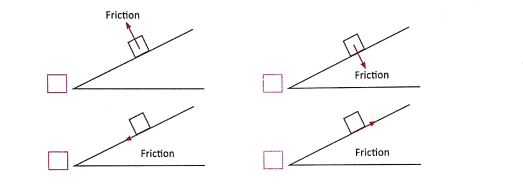
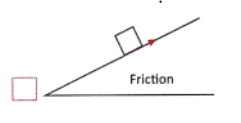
1. Suppose your writing desk is tilted to a position where a book kept on it just starts sliding down. The figure, showing the correct direction of frictional force acting on it, is—
Answer 1: (d)
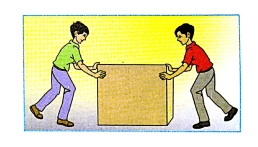
2. Two boys are applying oppositely directed, and equal in magnitude, forces on a box as shown in the figure.
In such a case, the force of friction, that would exist between the lower end of the box and the ground, would be called—
(a) sliding friction (b) static friction
(c) fluid friction (d) rolling friction
Answer 2: (b) static friction
3. Four students were asked to arrange the (frictional) forces, due to rolling, static and sliding friction, in increasing order. Their arrangements are listed below. The correct arrangement is —
(c) static, sliding, rolling (d) static, rolling, sliding
Answer 3: (b) rolling, sliding, static
4. The energy, ‘used up’ in overcoming friction, gets converted mainly into—
(a) sound energy (b) heat energy (c) light energy (d) chemical energy
Answer 4: (b) heat energy
5. Rahul rolls a ball on a wooden surface. The ball covers a certain distance before coming to rest. To make the same ball cover a (much) longer distance, before coming to rest, Rahul should—
(a) spread a newspaper on the wooden surface
(b) spread a towel on the wooden surface.
(c) sprinkle talcum powder on the wooden surface.
(d) spread a jute bag on the wooden surface.
Answer 5: (c) sprinkle talcum powder on the wooden surface.
6. A block is sliding on a horizontal surface. The force of friction between the two can be increased by—
(a) decreasing the area of contact of the block with the surface.
(b)applying a layer of some lubricant on the surface.
(c) by polishing the surface.
(d) by putting a second identical block on top of the given block.
Answer 6: (d) by putting a second identical block on top of the given block.
D. Answer the following questions in brief.
1. Define the terms (a) static friction (b) sliding friction.
Answer 1: (a) Static friction – The force of friction that exists between a stationary object and the surface on which it has been kept.
(b) Sliding friction- The friction that acts between an object and a surface when the object is sliding over that surface.
2. State the meanings of the terms (a) rolling friction (b) fluid friction.
Answer 2: (a) Rolling Friction – The force of friction resisting the (rolling) motion when a body rolls on a surface.
(b) Fluid friction – The frictional force exerted by fluids against a moving body.
3. State the likely cause of friction.
Answer 3: Friction is caused by the interlocking of irregularities in the surfaces of the two objects which are in contact with each other.
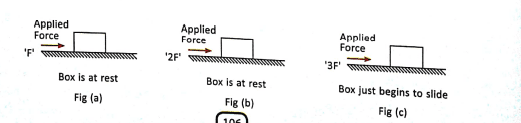
4. A box is resting on the floor. To move it, a (variable) force is applied as shown in the diagram below.
(a) Give the (likely) value of the force of limiting friction.
Answer 4(a): The value of limiting friction is 3F because the box is just beginning to slide over the surface when the applied force is 3F.
(b) Why does the box stay at rest in the cases corresponding to Fig (a) and Fig (b)?
Answer 4(b): The box stays at rest in the cases corresponding to Fig (a) and Fig (b) because applied force (F and 2F) is less than limiting friction(3F).
(c) Mark the direction of frictional force, and mention the kind of frictional force that comes into play, in each case.
Answer 4(c): The direction of frictional force is opposite to the applied force in each case.
The kind of frictional forces in each case are-
Case (a) – Static friction.
Case (b) – Static friction.
Case (c) – Limiting friction.
5. Name the kind of frictional friction, that comes into play, when a book, kept on a collection of cylindrical pencils, is moved by pushing it.
Answer 5: Rolling friction.
6. Why are objects given special shapes when they are moving through fluids? Write the name given to these special shapes?
Answer 6: Objects moving through fluids are given to a special shape to reduce the fluid friction. These special shapes are called streamlined shapes.
E. Answer the following questions.
1. Define Force of friction. List the factors affecting the force of friction. Explain with examples.
Answer 1: When two surfaces are in contact and one of them is moving in relation to the other, a counterforce opposes this motion. This force is called the force of friction.
Following factors affect the force of friction:
(i) Nature of the two surfaces in contact.
(ii) Force pressing the two surfaces towards each other.
Examples- (a) It is difficult to walk over a path that is covered with pebbles. But it is easier to walk over a smooth road. This happens because a rough surface gives more friction than a smooth surface.
(b) It is easier to slide a lightbox compared to a heavier box. This shows that the force pressing the two surfaces towards each other affects the friction.
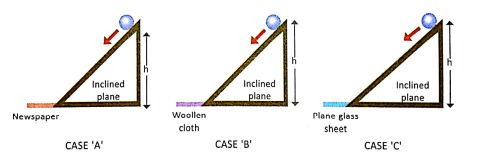
2. A ball is allowed to roll down an inclined wooden plane from a given height. At the foot of the inclined plane, it moves on a horizontal surface, differently ‘covered’, one by one, as shown in the following figures.
In which case, is the ball likely to move the longest distance? Give reason for your answer.
Answer 2: The ball is likely to move the longest distance in case ‘C’ because of the plane glass sheet. A glass sheet is highly smooth compared to a woollen cloth or a newspaper. So, the glass sheet would offer the least amount of friction.
3. Explain why sliding friction is slightly less than static friction.
Answer 3: Once an object begins to move over a surface, the interlocking between the two surfaces gets reduced. Due to this, sliding friction is slightly less than static friction.
4. Give reasons for the following—
(a) We tend to slip when we step on a banana peel.
Answer 4(a): A banana peel provides a very low amount of friction. Due to which it can easily move over a surface.
(b) It is easier to push a lighter box than a similar heavy box on the same floor.
Answer 4(b): This is because a lesser amount of force is needed to push the light box as compared to the heavier box.
(c) The force, needed to start a cart, is (somewhat) greater than the force needed to keep it moving with a uniform speed.
Answer 4(c): This is because more force is needed to move a stationary object as compared to keep moving it.
(d) Sportsmen use shoes fitted with spikes.
Answer 4(d): Spikes help in increasing the friction by creating more interlocking with the surface. This helps a sportsman to get a better grip while running.
(e) Ball-bearings are used in machines.
Answer 4(e): Ball bearings are used in machines to reduce the amount of friction.
(f) Tyres of the vehicles need to be changed regularly.
Answer 4(f): With passing time tyres get worn off and due to friction they become smoother.. (h) Streamlined shape helps in reducing fluid friction.
(g) Machines parts are frequently oiled or greased.
Answer 4(g): Oil or grease helps in reducing friction. This helps in smooth running of the machine parts
(h) Sports cars, aeroplanes and boats are designed to have a streamlined shape.
Answer 4(h): Streamlined shape helps in reducing fluid friction.
(i) Metal chains are wrapped on tyres when they run on icy roads.
Answer 4(i): Icy surface offers the least amount of friction. It is very difficult to drive over an icy surface. Metal chains are wrapped on tyres to increase friction.
(j) Rollers are used for transporting luggage.
Answer 4(j): We know that rolling friction is less than sliding friction. Rollers help in converting sliding friction into rolling friction. This makes it easier to move heavy luggage.
5. State and explain, with examples, how friction can help the cause of motion in certain situations.
Answer 5: Walking on a frictionless surface is almost impossible. Road’s surface is always made rough so that walking or driving becomes easier. Writing on a smooth and shiny surface is very difficult. But writing on a rough surface is quite easy. These examples show that friction is the cause of motion in certain situations.
Value Based Question
Ramit and Kush, both students of Class VIII, would often strongly argue with each other about the different aspects of their day-to-day school life. However, they made a very good ‘doubles team’ of their school, for the interschool badminton tournaments. When playing together, they would forget all their differences and play as a ‘team’ to ensure their school’s victory.
Their science teacher, who was also their badminton coach, would quote their example. He would explain to his students how the force of friction can be a ‘good friend’ and ‘a source of help’ even though it was usually viewed only as a ‘trouble maker’.
1. State the values displayed by Ramit and Kush.
2. Give two examples of situations in which the force of friction is a ‘source of help’.
3. Stage a play in which different members of two teams give examples to show that the force of friction is (i) a friend (ii) a foe.